


Our intredpid leader Frank Hassler will be giving a presentation tonight with Katie Heiber-Cobb of Sustainability on Stilts, at the Jensen Community Center in Amherst WI on Edible Native Plants and Urban Orchards.
For those of you in attendance, here is the list of edible wild plants:
Lots of interesting stuff here, including native trees shrubs and forbs that you might cultivate on your property as well as various weeds which you can harvest without regret!
Enjoy!
Good Oak News
Thursday, November 15, 2012

Sunday, October 21, 2012
Woodland Restoration By Seed
I recently had a potential client contact us asking about seeding into her woodland. The response I wrote her was pretty involved, so I thought it would be a good educational resource for others as well. Read on:
There are several factors to consider with seeding. If a woodland has a history of buckthorn infestation, it's important to know that buckthorn is allelopathic, meaning that it releases chemicals into the soil that inhibit the growth of other plants. Our understanding of how this works in buckthorn is in its infancy, but we do know that the chemicals affect some plants more than others and that it can take up to 4 years for these chemicals to break down or flush out of the soil after a dense infestation of buckthorn has been removed. It is possible that honeysuckle or other invasive plants are also allelopathic, but the research has not been done yet. Garlic mustard, for example, kills off beneficial soil fungus that form symbiotic relationships with many native plants. At the moment, we are recommending only planting live plants in dense buckthorn areas the first year after removal and waiting 2-4 years to do seeding.
Another factor to consider is sunlight availability. Seeds only do well when there is ample light. As we mention in our recent mailer, the woodlands in our area were originally more open than they are today with much more light to help these ground layer plants germinate, grow and prosper. Some woodland plants can be established by seed but many can only be established by live plants, including the most shade tolerant species. It is likely you may need to do additional tree thinning to open up the canopy enough for seedling plants (and young oaks!) to prosper. Trees we typically target right away are mulberry (also exotic) and boxelder. Other trees we selectively thin out to open the canopy include cherry, walnut, hackberry, ash, elm, basswood and maple.
Otherwise, for more shaded areas you will have to stick to more shade tolerant, live plants. The more shade tolerant species tend to be difficult to establish by seed for various reasons due to difficulty in collecting, cleaning, storing and otherwise preparing the seeds (the more open woodland species are more often wind-born seeds which are easier to collect, process and store). These plants also tend to only bloom in the spring or not have showy flowers (such as ferns). A healthy woodland should have plants that are green and flowering year-round, so brush removal and tree thinning are an important first step, then a mix of planting and seeding are often necessary to reestablish the biological diversity of the habitat.
Lastly, seeds need good seed-to-soil contact and light to germinate. Most of our woodlands have a layer of leaf litter that prevents these two components from being found in the same place. Naturally regular, low-intensity ground fires would have removed this leaf litter letting the seeds meet the soil and the sun. So leaf-litter needs to be removed before seeding, usually we do this by a prescribed burn, in order to allow for germination.
We have a custom seed mix we have developed with our seed supplier that includes many of the species on the below table, as well as some savanna species. This mix does pretty well in open woodlands, and can be planted in late fall or spring. But don't expect immediate results, these take a few years to get established. Also, there are many other species that should/could be seeded into a woodland that are not commercially available. A few that come to mind include white lettuce (a.k.a. lion's foot), yellow pimpernel, wild hyacinth, blue-eyed Mary, other woodland sunflowers, and a wide variety of sedges (Carex albursina, C. blanda, C. jamesii C. pensylvanica, C. radiata, C. rosea, and others depending on specific site conditions), but there are many others. These may need to be collected, with permission of the owner, from local sites.
There are several factors to consider with seeding. If a woodland has a history of buckthorn infestation, it's important to know that buckthorn is allelopathic, meaning that it releases chemicals into the soil that inhibit the growth of other plants. Our understanding of how this works in buckthorn is in its infancy, but we do know that the chemicals affect some plants more than others and that it can take up to 4 years for these chemicals to break down or flush out of the soil after a dense infestation of buckthorn has been removed. It is possible that honeysuckle or other invasive plants are also allelopathic, but the research has not been done yet. Garlic mustard, for example, kills off beneficial soil fungus that form symbiotic relationships with many native plants. At the moment, we are recommending only planting live plants in dense buckthorn areas the first year after removal and waiting 2-4 years to do seeding.
Another factor to consider is sunlight availability. Seeds only do well when there is ample light. As we mention in our recent mailer, the woodlands in our area were originally more open than they are today with much more light to help these ground layer plants germinate, grow and prosper. Some woodland plants can be established by seed but many can only be established by live plants, including the most shade tolerant species. It is likely you may need to do additional tree thinning to open up the canopy enough for seedling plants (and young oaks!) to prosper. Trees we typically target right away are mulberry (also exotic) and boxelder. Other trees we selectively thin out to open the canopy include cherry, walnut, hackberry, ash, elm, basswood and maple.
 |
| This "Sugar Maple Deadzone" in a local woodland is much too dark to support productive ground-layer plants and will need to be thinned out before restoration can begin. |
Otherwise, for more shaded areas you will have to stick to more shade tolerant, live plants. The more shade tolerant species tend to be difficult to establish by seed for various reasons due to difficulty in collecting, cleaning, storing and otherwise preparing the seeds (the more open woodland species are more often wind-born seeds which are easier to collect, process and store). These plants also tend to only bloom in the spring or not have showy flowers (such as ferns). A healthy woodland should have plants that are green and flowering year-round, so brush removal and tree thinning are an important first step, then a mix of planting and seeding are often necessary to reestablish the biological diversity of the habitat.
Lastly, seeds need good seed-to-soil contact and light to germinate. Most of our woodlands have a layer of leaf litter that prevents these two components from being found in the same place. Naturally regular, low-intensity ground fires would have removed this leaf litter letting the seeds meet the soil and the sun. So leaf-litter needs to be removed before seeding, usually we do this by a prescribed burn, in order to allow for germination.
 |
| The Vestal Grove in Somme Prairie Grove has been revegetated largely by seeding, with some remnant plants and some planting as well. Brush removal is the first step and prescribed fire is critical for maintenance. This is one of the best examples of a healthy woodland in the Midwest. |
We have a custom seed mix we have developed with our seed supplier that includes many of the species on the below table, as well as some savanna species. This mix does pretty well in open woodlands, and can be planted in late fall or spring. But don't expect immediate results, these take a few years to get established. Also, there are many other species that should/could be seeded into a woodland that are not commercially available. A few that come to mind include white lettuce (a.k.a. lion's foot), yellow pimpernel, wild hyacinth, blue-eyed Mary, other woodland sunflowers, and a wide variety of sedges (Carex albursina, C. blanda, C. jamesii C. pensylvanica, C. radiata, C. rosea, and others depending on specific site conditions), but there are many others. These may need to be collected, with permission of the owner, from local sites.
| Native Woodland/Savanna Plants available by seed in the Upper Midwest | |
| Sci. Name | Common Name |
| Agastache nepetoides | Giant Yellow Hyssop |
| Agastache scrophulariaefolia | Purple Hyssop |
| Allium cernuum | Nodding Pink Onion |
| Anemone virginiana | Tall Anemone |
| Aquilegia canadensis | Wild Columbine |
| Aster drummondii | Drummond's Aster |
| Aster lateriflorus | Side-flowering aster |
| Aster sagittifolius | Arrow-leaved Aster |
| Aster shortii | Shorts Aster |
| Blephilia hirsuta | Hairy Wood Mint |
| Bromus purgans Carex springelii |
Woodland Brome Springell's sedge |
| Campanula americana | Tall Bellflower |
| Dodecatheon meadia | Shooting Star |
| Echinacea pallida | Pale Purple Coneflower |
| Elymus histrix | bottlebrush grass |
| Elymus villosus | Silky Wild Rye |
| Elymus virginicus | Virginia Wild Rye |
| Eupatorium purpureum | Purple Joe Pye Weed |
| Eryngium yuccafolium | rattlesnake master |
| Geranium maculatum | Wild Geranium |
| Helianthus strumosus | Woodland Sunflower |
| Monarda fistulosa | Wild Bergamot |
| Penstemon digitalis | Foxglove Beardtongue |
| Rudbeckia subtomentosa | Sweet Black-eyed Susan |
| Rudbeckia triloba | Brown-eyed Susan |
| Scrophularia lanceolata | Early Figwort |
| Solidago caesia | Blue-stemmed goldenrod |
| Solidago flexicaulis | Zig-zag Goldenrod |
| Solidago ulmifolia | Elm-Leaved Goldenrod |
| Tradescantia subaspera | Zig-zag spiderwort |
| Tradescantia virginiana | Virginia spiderwort |
| Veronicastrum virginicum | Culver's Root |
| Zizia aurea | Golden Alexander |
Tuesday, September 25, 2012
Announcing Good Oak's Fall Plant Sale!
Its that time of year again, leaves are starting to turn, and we once again have a few too many plants left around Good Oak World Headquarters. So I'm announcing our Fall Native Plant Sale to clear the shelves an give you a chance to get a great deal on native perennials for your garden! See the list below, which I will do my best to keep updated daily. We're starting out with over 400 plants that have got to go! Save 30-60% off of normal retail price!
Fall is the best time to plant perennials. With cooler temperatures as the growing season comes to a close the plants have great conditions to settle in this fall and plenty of time next spring to put down roots before the stressful heat of summer. So take advantage of these deals and get planting!
Availability is limited, so please email me at frank at goodoak dot com, to place an order and call "dibs" on your plants!
UPDATED: 10/14/12 @ 6:45pm.
| Common Name | Scientific Name | Size | Qty | SALE PRICE | Notes |
| butterfly milkweed | Asclepias tuberosa | 2.5” plug | 2 | $3.00 | |
| Bicknell's sedge | Carex bicknellii | quart | 6 | $2.00 | leggy divided plants |
| ivory sedge | Carex emeryi | 2.5” plug | 13 | $3.00 | nice looking, for sedge lawn |
| turtlehead | Chelone glabra | 2.5” plug | 6 | $2.00 | |
| Virgin's bower | Clematis virginiana | quart | 5 | $3.00 | |
| pagoda dogwood | Cornus alternifolia | 1-gallon | 1 | $9.00 | ~18” tall |
| pagoda dogwood | Cornus alternifolia | 2-gallon | 1 | $14.00 | ~2.5” tall |
| pale purple coneflower | Echinacea pallida | 2.5” plug | 7 | $1.00 | small |
| pale purple coneflower | Echinacea pallida | 2.5” plug | 8 | $2.50 | |
| bottlebrush grass | Elymus hystrix | 2.5” plug | 12 | $2.00 | |
| bottlebrush grass | Elymus hystrix | quart | 5 | $3.00 | |
| Virginia wild-rye | Elymus virginicus | quart | 1 | $2.50 | |
| white trout lily | Erythronium albidum | 2.5” plug | 28 | $4.00 | dormant |
| purple joe pye weed | Eupatorium purpureum | 2.5” plug | 26 | $2.00 | |
| purple joe pye weed | Eupatorium purpureum | quart | 1 | $3.00 | |
| smooth rose mallow | Hibiscus laevis | quart | 9 | $6.00 | wet spots only |
| common juniper | Juniperus communis | quart | 1 | $4.00 | Possibly virginiana? Great bonsai tree! |
| Virginia bluebells | Mertensia virginica | quart | 1 | $3.00 | |
| prickly pears | Opuntia humifusa | quart | 34 | $5.00 | |
| solomon's seal | Polygonatum biflorum | Gallon+ | 33 | $5.00 | bare root in pot |
| solomon's seal | Polygonatum biflorum | quart | 32 | $3.00 | bare root in pot |
| early wild rose | Rosa blanda | quart | 1 | $4.00 | |
| Black-eyed susan | Rudbeckia hirta | 2.5” plug | 2 | $2.00 | |
| little blue stem | Schizachyrium scoparium | 2.5” plug | 7 | $2.50 | |
| stiff goldenrod | Solidago rigida | 2.5” plug | 8 | $2.50 | |
| elm-leaved goldenrod | Solidago ulmifolia | quart | 4 | $4.00 |
Fall is the best time to plant perennials. With cooler temperatures as the growing season comes to a close the plants have great conditions to settle in this fall and plenty of time next spring to put down roots before the stressful heat of summer. So take advantage of these deals and get planting!
Availability is limited, so please email me at frank at goodoak dot com, to place an order and call "dibs" on your plants!
UPDATED: 10/14/12 @ 6:45pm.
Friday, September 7, 2012
The Indomitable Hairy Aster
You can tell it's fall because the asters are starting to bloom. There are about 25 species of asters in southern Wisconsin so these species can get pretty confusing (and even more so now that the taxonomists have split this genus into three four genera, none of which are named "Aster".) Most of these asters are relatively rare on the landscape, restricted to remnant prairies, wetland and woodlands. But one species I really enjoy seeing in all sorts of odd places is hairy aster (Symphyotrichum pilosum, formerly known as Aster pilosus).

This scrappy little species is common throughout the landscape. It is a component of high-quality prairies and savannas, rubbing elbows with the most conservative of prairie plants, but can also be found duking it out with the weeds on roadsides, old fields and urban waste areas. It often 'just shows up' in prairie plantings and formal gardens alike. In fact, I have about a dozen in my yard and I never planted a single one of them. It is often considered a weed, and the overall structure of the plant is relatively unattractive with a hairy, spreading stem and long, skinny leaves. But it is a great source of pollen and nectar for butterflies and bees, and once it starts blooming its bright flowers can cheer up any garden. Plus, it blooms from late August all the way until early November. Another great attribute is that it never spreads aggressively like its distant cousin Canada goldenrod, which also tends to "just show up" in a garden or prairie.
So keep an eye out for hairy aster this fall. Chances are, if you see a white aster in full sun or light shade, outside of a wetland or remnant prairie, this is it. You may not know every aster species in our area, but you can be pretty confident that just about every one you will see on a day-to-day basis will be this exuberant species.

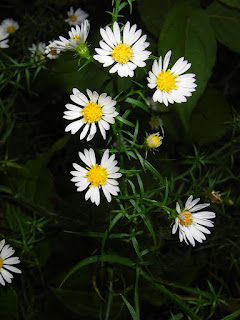


This scrappy little species is common throughout the landscape. It is a component of high-quality prairies and savannas, rubbing elbows with the most conservative of prairie plants, but can also be found duking it out with the weeds on roadsides, old fields and urban waste areas. It often 'just shows up' in prairie plantings and formal gardens alike. In fact, I have about a dozen in my yard and I never planted a single one of them. It is often considered a weed, and the overall structure of the plant is relatively unattractive with a hairy, spreading stem and long, skinny leaves. But it is a great source of pollen and nectar for butterflies and bees, and once it starts blooming its bright flowers can cheer up any garden. Plus, it blooms from late August all the way until early November. Another great attribute is that it never spreads aggressively like its distant cousin Canada goldenrod, which also tends to "just show up" in a garden or prairie.
So keep an eye out for hairy aster this fall. Chances are, if you see a white aster in full sun or light shade, outside of a wetland or remnant prairie, this is it. You may not know every aster species in our area, but you can be pretty confident that just about every one you will see on a day-to-day basis will be this exuberant species.


Saturday, July 21, 2012
SAVE THE MONARCHS! Great deals on butterfly gardens!
Today we're announcing our SAVE THE MONARCHS! Butterfly Garden promotional program:

Though they are one of our most common, and most beautiful American butterflies, the future of the monarchs is in doubt due to habitat loss and other threats. Help us help you SAVE THE MONARCHS! By participating in our program.
At select special events we will be giving away free milkweed plants: Come find out booth at the Atwood Summerfest on Saturday July 28th and Sunday 29th where we will be giving away over 200 butterfly milkweed plants and common milkweed seeds
Special Monarch Garden Packages: We have developed several special “Monarch Garden” packages, both gardens we can install for you and kits for the DIY folks. To encourage people to 'go native' we're offering these kits at 22-33% off the normal retail price of plants and/or installation!
*Additional travel fee for projects outside of Dane County.
We have put together lots of great info about monarch butterflies, the various threats to their survival and what you can do on our new Monarch Page. Check it out!

Though they are one of our most common, and most beautiful American butterflies, the future of the monarchs is in doubt due to habitat loss and other threats. Help us help you SAVE THE MONARCHS! By participating in our program.
At select special events we will be giving away free milkweed plants: Come find out booth at the Atwood Summerfest on Saturday July 28th and Sunday 29th where we will be giving away over 200 butterfly milkweed plants and common milkweed seeds
Special Monarch Garden Packages: We have developed several special “Monarch Garden” packages, both gardens we can install for you and kits for the DIY folks. To encourage people to 'go native' we're offering these kits at 22-33% off the normal retail price of plants and/or installation!
- Standard Monarch Garden: 52 native flowers and grasses, including up to 12 milkweeds. Different packages are available for sun, moderate shade and rain garden sites. Site preparation (weeding, sod removal), installation, mulching and initial watering are included. We can plant this garden in an area to remove a bit of lawn (about 50 square feet) or it can be interplanted into an existing flower bed. Regular Price: $531. SAVE THE MONARCHS! Program sale price: $435!*
- DIY Monarch Garden Kit: 52 native flowers and grasses, including up to 12 milkweeds, ½ cubic yard of mulch and basic instructions. Different packages are available for sun, moderate shade and rain garden sites. Regular Price: $293. SAVE THE MONARCHS! Program sale price: $221!*
- For additional savings, buy one butterfly garden, get $10 off the second! Double the size of the garden, double the number of butterflies! For the DIY Package, consider a group buy with your friends and neighbors so everyone can save!
*Additional travel fee for projects outside of Dane County.
We have put together lots of great info about monarch butterflies, the various threats to their survival and what you can do on our new Monarch Page. Check it out!
Subscribe to:
Posts (Atom)